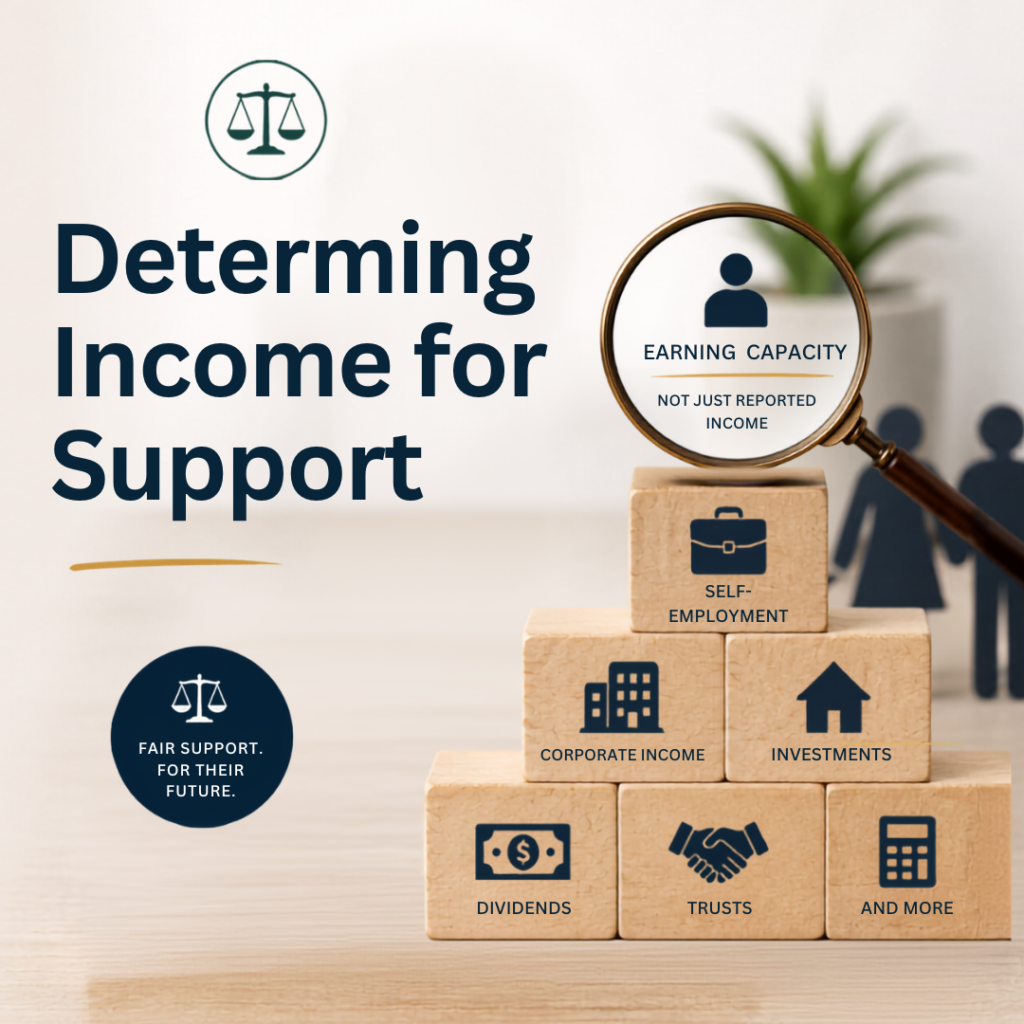
In Ontario family law, support is usually calculated from a party’s actual income. But where reported income does not fairly reflect earning capacity or available resources, the court may “impute” income by assigning an amount for support purposes.
For child support, section 19 of the Federal Child Support Guidelines and Ontario’s Child Support Guidelines permits imputation in circumstances such as intentional unemployment or under-employment, diverted income, failure to disclose, unreasonable deductions, income taxed at lower rates, or property not reasonably used to generate income. The Ontario Court of Appeal’s leading case, Drygala v. Pauli, asks whether the party is intentionally unemployed or under-employed; whether that is required by a child’s needs or the party’s reasonable education or health needs; and, if not, what income is fair to impute. Bad faith is not required.
This is particularly important because child support is the right of the child. As a result, courts are interested in ensuring that all relevant income information is disclosed and considered. Parents cannot simply agree to use an artificially reduced income figure to settle a case if doing so compromises proper child support. The Supreme Court of Canada has recognized that courts may intervene to determine the proper level of support because child support belongs to the child.
Disclosure is central. Section 21 of the Guidelines requires disclosure of income information, including tax returns, notices of assessment, pay details, and additional materials for self-employed spouses, partners, corporate controllers, trust beneficiaries, and other non-standard income sources.
Imputing income can apply to payors and recipients. For payors, it prevents table support from being based on artificially low income. For recipients, income may affect spousal support, proportional sharing of section 7 special or extraordinary expenses, and child support cases that involve adult-child support, split or shared parenting time, incomes over $150,000, stepparent cases, and undue hardship.
For payors with anything other than straightforward T4 employment income — such as self-employment income, corporate income, dividends, retained earnings, cash income, partnership income, trust benefits, or significant deductions — the best step is to speak with a family law lawyer early. Fulsome disclosure is the foundation of family law. Mishandling income disclosure or income determination can create credibility problems, support arrears, cost consequences, and repercussions that follow a payor throughout the proceeding. This is important to get right. At the Ross Firm, we can help you understand what must be disclosed, how income may be determined, and how to present a clear, accurate support position.
Separation can be complicated, our expert family team at the Ross Firm can help. Contact [email protected] to set up your consultation.
Disclaimer: the above information does not constitute legal advice. We strongly recommend obtaining independent legal advice with respect to any legal issues.