For decades, survivors of domestic abuse seeking financial accountability through civil courts were forced to squeeze their experiences into a rigid legal framework. Family law litigants in Ontario had to present a pattern of abuse as a series of isolated, disjointed events—pleading separate claims for assault, battery, or the intentional infliction of emotional distress.
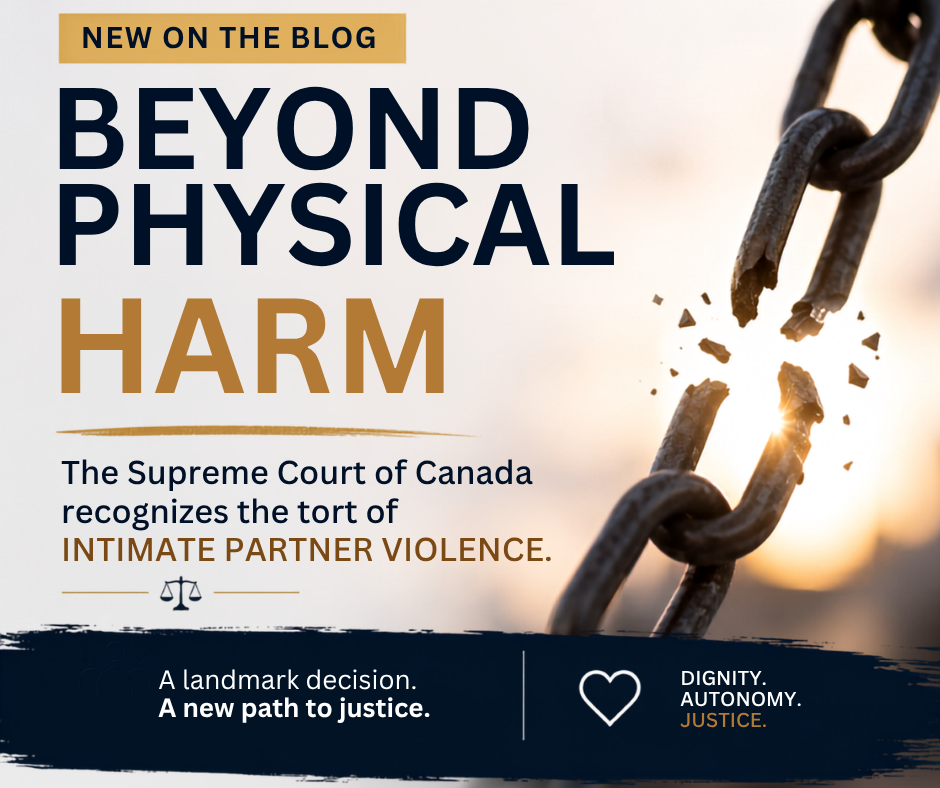
On May 15, 2026, the Supreme Court of Canada fundamentally shifted this paradigm. In its historic 6–3 decision in Ahluwalia v. Ahluwalia, 2026 SCC 16, the country’s highest court officially recognized the tort of intimate partner violence. This landmark ruling marks a profound evolution in Canadian jurisprudence and sets a progressive international standard for how civil legal systems recognize systemic, non-physical harm.
Why Existing Torts Fell Short
Historically, tort law operated on an incident-based model. While a singular physical assault or an explicit threat could be categorized under existing claims, these traditional frameworks routinely failed to capture the true mechanics of intimate partner violence and coercive control
Intimate partner violence is a “pernicious social ill” defined by its cumulative, patterned nature. Abuse within an intimate relationship is rarely just a collection of disconnected bad days; it is a sustained course of conduct aimed at the total erosion of a partner’s independence. Prior to Ahluwalia, there was a distinct legal gap: no existing tort compensated a victim for the invisible, grinding destruction of their autonomy, dignity, and equality.
The Legal Test: Proving the New Tort
To establish civil liability for the tort of intimate partner violence, a plaintiff must satisfy a three-pronged test:
- The Relationship Requirement: The abusive conduct must have arisen within an intimate partnership or during its aftermath.
- Intentional Conduct: The defendant must have intentionally engaged in the abusive behavior. Crucially, the plaintiff does not need to prove that the abuser subjectively intended to dominate them—only that the actions themselves were deliberate.
- Objective Coercive Control: Viewed as a whole and in context, the behavior must meet the objective standard of coercive control.
Under this framework, courts will look beyond physical marks to evaluate tactics such as financial deprivation, forced isolation, algorithmic surveillance, relentless humiliation, and litigation abuse.
A Groundbreaking Global Precedent
The Ahluwalia decision is being watched closely worldwide because it elevates the concept of coercive control from a statutory family law factor into a standalone, compensable civil wrong. By linking civil liability directly to values of dignity and personal autonomy, the Supreme Court of Canada has acknowledged that losing your freedom within your own home is a severe breach of your fundamental rights.
What This Means for Family Law Litigants in Ontario
This ruling introduces an essential, backward-looking tool for family law proceedings. While statutory instruments like Ontario’s Family Law Act or the federal Divorce Act offer forward-looking protection and conduct orders, the new tort allows survivors to directly pursue civil financial damages for the long-term harms they endured.
Navigating family litigation where coercive control is present requires an analytical, cautious approach to ensuring these complex dynamics are accurately presented to the court. If you are navigating a high-conflict separation and require strategic, experienced legal counsel to assess your options, reach out to our team.