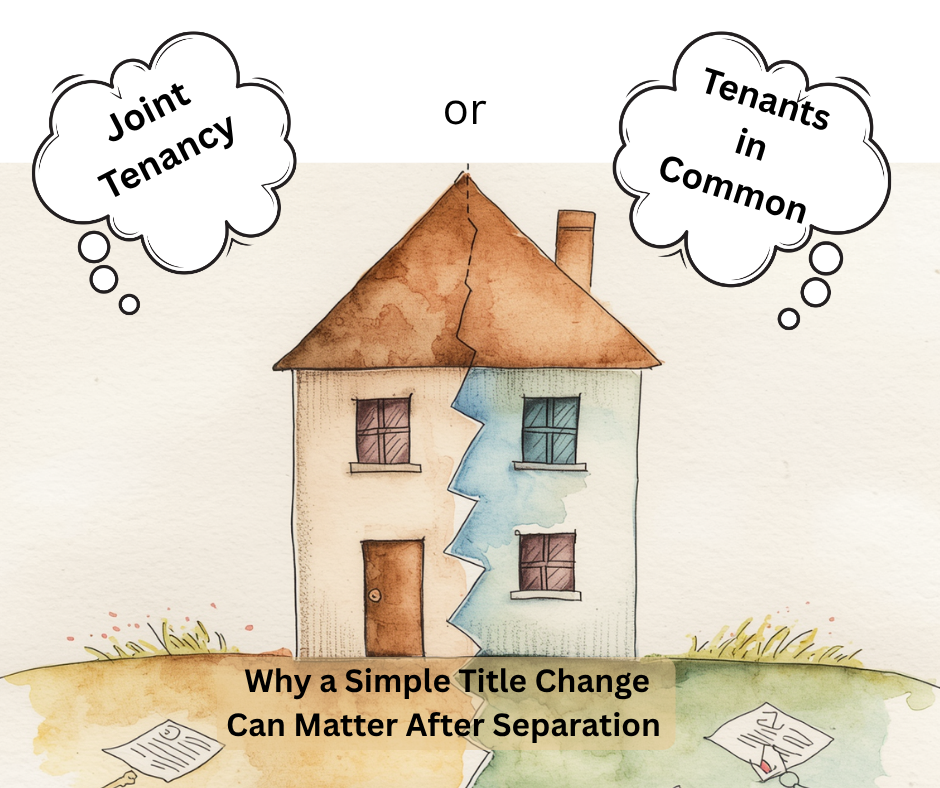
When two people own a property as joint tenants, they own it together and, importantly, there is a right of survivorship. That means if one owner dies, the other usually becomes the owner automatically. If the joint tenancy is severed, the owners instead become tenants in common. In plain English, that means each person has a separate share of the property, and that share goes to their estate rather than automatically to the other owner. In Ontario, co-owners can hold title either way, and a joint tenancy can be severed by registration.
From a family law perspective, this issue often comes up after separation, especially where there is a matrimonial home, cottage, or investment property. Severing joint tenancy can make sense where one person wants to protect their share, preserve it for children or other beneficiaries, or avoid a situation where survivorship changes the result before the family law issues are sorted out. But it is not a magic fix. For married spouses, Ontario law generally gives both spouses an equal right to possess a matrimonial home, even if only one spouse is on title. In other words, changing title does not automatically decide who stays in the home or how the broader property issues will be resolved.
There can be real benefits to severing joint tenancy. It may better match a person’s estate plan, reduce the risk of an unintended automatic transfer on death, and create clearer separation between the owners’ interests. On the other hand, there are drawbacks. It can increase conflict, and in some cases, it can also cause people to assume the property issue has been “dealt with” when it has only been partly addressed.
Timing is often the key. If separation has happened — or is likely — it is usually better to get advice before a death, sale, refinance, or rushed agreement changes the picture. This is especially important because common-law partners and married spouses do not have the same property rights in Ontario, and the term matrimonial home has special legal meaning for married spouses. The safest approach is usually to look at title, family law claims, wills, and mortgage issues together before taking a step that may be difficult to reverse.
If you are separating and jointly own a home, cottage, or investment property, getting legal advice early can help you avoid costly surprises and make sure your title reflects your legal and practical goals.
Separation can be complicated, our expert family team at the Ross Firm can help. Contact [email protected] to set up your consultation.
Disclaimer: the above information does not constitute legal advice. We strongly recommend obtaining independent legal advice with respect to any legal issues.